Frankendiff, a reading tool for Frankenstein.
Mary Shelley published Frankenstein in 1818 and returned to it more than a decade later, producing a substantially revised edition in 1831. The two texts differ in hundreds of small and large ways: typographical corrections, altered phrasing, and passages rewritten or expanded.
Frankendiff makes it possible to read these editions side by side in spirit, moving easily between them and seeing exactly where the text changed. A diff view marks every insertion and deletion inline, allowing the revisions to appear directly within the flow of the novel.
The relationship between the 1818 and 1831 texts has long been studied and documented in scholarly editions. Frankendiff approaches that history in a simpler way: by making the changes visible within the text itself, and freely accessible to anyone who wishes to explore them while reading.
The two editions
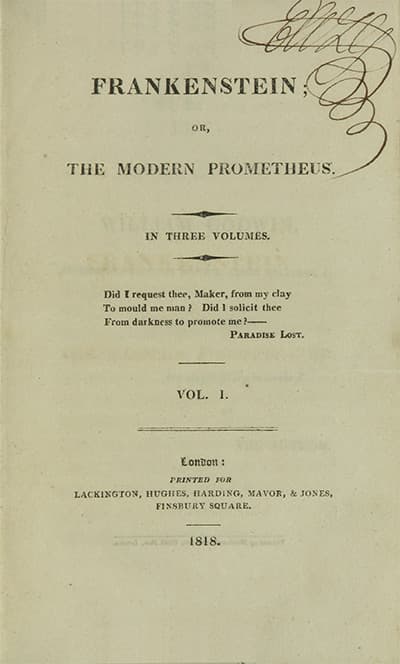
1818 The original text
The first edition was published anonymously in three volumes on 1 January 1818 by Lackington, Hughes, Harding, Mavor & Jones, with a preface written by Percy Bysshe Shelley. It is often regarded as the more radical version of the novel: politically sharper, less overtly moralizing, and closer in spirit to the intellectual circle of Godwin, Wollstonecraft, and the Shelleys in which it was conceived. Mary Shelley was twenty years old when the novel first appeared.
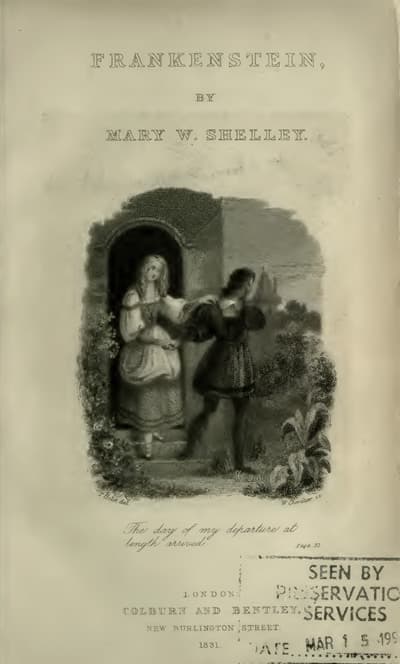
1831 The revised edition
The 1831 edition was published as part of Bentley’s Standard Novels series. Shelley revised the text extensively: she softened some of the more provocative passages, expanded Victor Frankenstein’s childhood and backstory, and shifted the novel’s framing toward a more fatalistic, providential tone. She also added a new author’s introduction —now almost as famous as the novel itself— describing how she came to write the story during the “wet, ungenial summer” at the Villa Diodati in 1816.
What about the 1823 edition?
A second edition was published in two volumes in 1823 by G. and W.B. Whittaker. It has one notable distinction: it was the first edition to carry Shelley’s name on the title page, rather than the anonymous attribution of the 1818 printing.
Beyond that, the 1823 edition introduced relatively few changes, mainly correcting typographical errors and some minor stylistic inconsistencies from the 1818 text. It does not represent a significant editorial intervention in the way the 1831 revision does. For that reason it is not included in this project: the editorial story worth telling is the contrast between the raw 1818 first edition and the considered, heavily revised 1831 text.
Who made this?
Frankendiff is a personal project by Eduardo Villuendas , built mostly for fun. It started after I realized how surprisingly difficult it can be to tell which version of Frankenstein one is reading. Many editions quietly follow the 1831 text, while others reproduce the 1818 version, and the differences between them are not always easy to spot.
I thought it might be useful to make those changes easier to see while reading, so I put this site together.
Frankendiff is not affiliated with any institution.
If you notice an error in the text, a misaligned paragraph, or anything else worth fixing —or if you simply have something to share— you are welcome to write to hello@frankendiff.com.
The code is open source. You can browse it, report a problem, or propose a fix on GitHub .
Sources
All texts and images used in this project are in the public domain.
- 1818 — transcriptionWikisource — Frankenstein, or the Modern Prometheus, (First Edition, 1818)
- 1818 — facsimile, volume IInternet Archive — Frankenstein, 1818, vol. I
- 1818 — facsimile, volume IIInternet Archive — Frankenstein, 1818, vol. II
- 1818 — facsimile, volume IIIInternet Archive — Frankenstein, 1818, vol. III
- 1831 — transcriptionWikisource — Frankenstein, or the Modern Prometheus, (Revised Edition, 1831)
- 1831 — facsimileInternet Archive — Frankenstein, 1831
- 1831 — front matter illustrationsPublic Domain Image Archive — Frankenstein, 1831 front matter illustration
Thank you for your time!
— New York City, March 2026